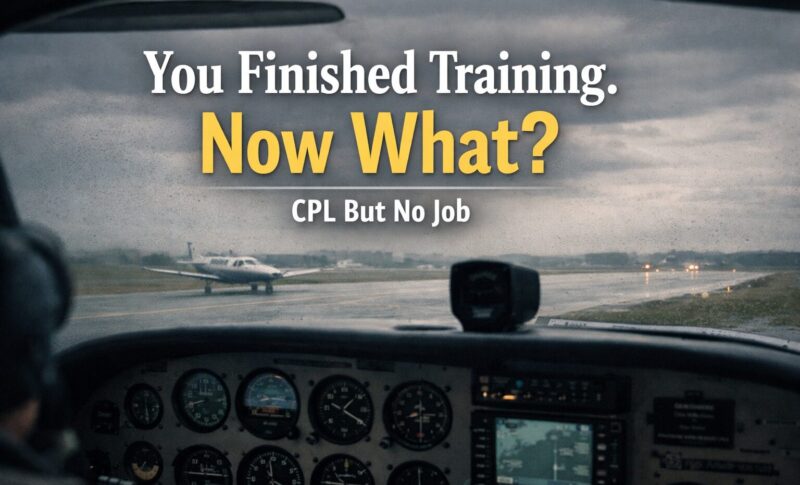
What Am I Supposed to Do?
That feeling you have — it’s not wrong.
You worked for it.
You pushed through training.
You earned your CPL.
And yet, after being released from the cage,
there’s no nest waiting for you.
You can fly on your own now.
You can make difficult decisions.
You’ve proven that.
So why?
It feels like your training is over —
but somehow, you’re still attached to it.
Like invisible strings are holding you back,
leaving you drifting with no clear direction.
This is the reality of the pilot training industry today.
Why You’re Still Stuck
The CPL you obtained —
In the U.S., typically 250+ hours.
In Canada, around 200+ hours.
In Australia or New Zealand, around 150+ hours.
These numbers are not random.
They are based on national regulations and each country’s training philosophy.
In other words — the system itself is not broken.
The real problem is the gap.
To work at charter operators or sightseeing companies,
the practical expectation is very different.
Around 500 hours at minimum.
Ideally 1,000 hours or more.
You’ll often see requirements like:
1,000+ total hours, 300+ PIC.
But think about it.
Would a pilot at that level intentionally choose
a charter or sightseeing role as their next step?
This is not about ranking those jobs lower.
It’s about career logic.
At that level, moving to the next stage is often the more rational path.
Now look at it from the company side.
Charter operators have limited resources.
They must hire and train within tight constraints.
Training a 500-hour pilot versus a 1,000-hour pilot
creates a significant difference in cost.
That difference is real cash out.
So let’s go back to the core point.
Training and hiring are two completely different worlds.
As explained in another article:
The Brutal Reality of Low Hour Pilot Jobs
Flight schools train you to a safe, operational level.
Companies hire what they consider a “finished product.”
And that definition of “finished” is the real problem.
Companies avoid unnecessary risk.
Safety, personality, consistency, growth potential —
what seems like individual factors
directly impact operations, internal stability, and ultimately performance.
Hiring acts like a firewall.
It filters risk before it enters the system.
And yet —
there is something fundamentally wrong with this structure.
Why are you, despite having a license,
forced to compete on the same field
with a 300 to 700 hour gap still unfilled?
The real issue is simple:
The bridge between training and employment is broken.
What’s Really Happening
You often hear about a pilot shortage.
Yet hiring does not seem active.
And you rarely see actual job openings.
That is not a contradiction.
In many cases, the industry is partially closed by design.
(We will break this down in another article.)
Not every company can publish job postings.
Some don’t have the know-how.
Some don’t even know where or how to post.
Which means —
Many opportunities are never made public.
Or even when they are,
companies may want to post multiple hiring profiles,
but due to budget constraints,
they can only publish one.
And naturally — they prioritize the “safe” option.
1,000 hours total. 300 PIC.
That’s what you see.
But inside the field, the conversation is often different.
You will hear things like:
“If someone has around 500 hours and 150 PIC,
we’d consider starting them as a junior.”
The problem is not willingness.
It’s cost.
On most hiring platforms,
listing a job costs the same — regardless of level.
So companies are forced to choose:
Spend money hiring a high-hour, lower-risk pilot,
or take a chance on a lower-hour candidate.
And most will choose the former.
What happens next?
They hire someone — and then ask:
“Do you know anyone else?”
And hiring moves through connections.
Not necessarily based on skill or potential,
but on proximity and trust networks.
From experience, this kind of system rarely produces consistent results.
It often turns into a cycle of trust trading,
where internal positioning is maintained
rather than actual performance being evaluated.
This is what I call an “Unworkable Filtering System.”
Hiring someone through someone else’s filter
is not a functioning system.
The most critical parts of this industry
are the ones you don’t see.
Now, What You Are Supposed to Do
First of all.
I’ll give you three tips.
・Just move on
・See where you’re standing
・Change your perspective
Most people are missing what actually matters.
Nearly 80% of pilots think based only on their license, total hours, or age.
But that alone doesn’t tell you where you truly fit in the market.
I define five essential qualities for pilots:
Social awareness
Wide perspective
Decision-making
Judgment
Adaptability
Especially “wide perspective” — this is where it matters most.
If you only look at your instrument panel,
you won’t see anything new.
But the moment you look outside,
new information appears.
It’s the same in your career.
You need to understand the hiring structure,
and build a strategy where you actually fit into the market.
Start here:
Easy 3-Question Start
Tell me your current situation and challenges.
I will personally respond within 48 hours.
No fee.
Nothing starts until you register.
Free Registration