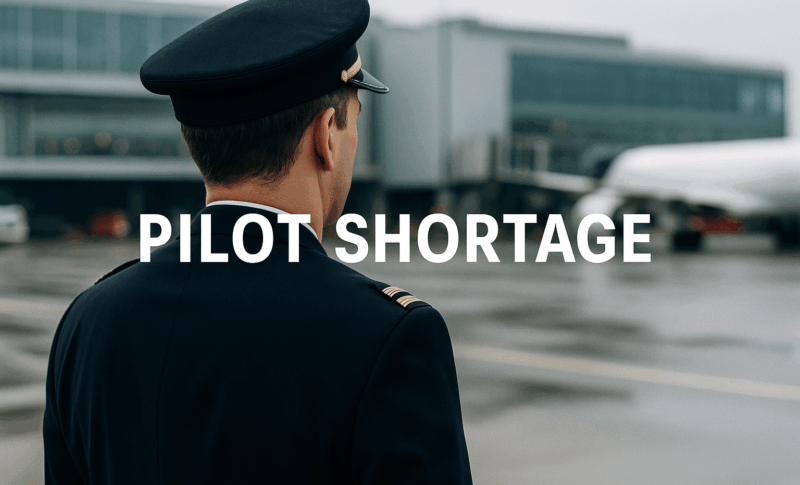
The Pilot Shortage Is Not a News Cycle. It Is a Structural Crisis.
You have seen the headlines. “Pilot shortage worsens.” “Airlines scramble for crew.” The story runs, then disappears, then runs again.
But the underlying reality does not disappear. Based on years of direct visits to flight schools and airlines worldwide, combined with Boeing forecast data, our founder has calculated that even if global flight schools operated at 70 percent capacity and birth and education rates held steady — the world will face a physical shortfall of approximately 200,000 pilots by around 2040.
Boeing’s own Pilot and Technician Outlook projects that over 600,000 new pilots will be needed globally over the next two decades. The infrastructure to produce even 400,000 of them does not currently exist.
Economy class. Non-refundable. No seat selection. 10kg baggage allowance. Round trip: $3,000.
The structural pilot shortage feeds directly into airfare. It is already hitting passengers who have no idea why.
The Shortage by Region.
North America.
Post-pandemic early retirements accelerated an already-developing generational gap. The boomer retirement wave is ongoing. Major carriers have responded by pulling experienced pilots from regional operators — leaving regional aviation in a significantly worse position than the headline numbers suggest. Only a handful of the largest carriers have anything approaching stable pipeline access.
Europe.
Low-cost carrier expansion has driven demand significantly higher while regulatory complexity and training costs have kept supply constrained. The LCC proliferation has accelerated the shortage rather than solving it.
Asia and the Middle East.
Economic growth has driven aviation demand at a pace that training infrastructure cannot match. The Middle East continues large-scale international recruitment as a structural feature of its aviation model, not a temporary measure. Markets in South and Southeast Asia are growing faster than the pilots to serve them.
The Numbers Over the Next Decade.
Boeing’s Pilot Outlook projects more than 650,000 new pilots needed globally by 2042. Asia-Pacific and the Middle East show the highest growth trajectories. Training infrastructure, instructor supply, and cost barriers mean supply will not keep pace — not without significant structural change.
Why the Shortage Happened.
The Pipeline Broke Down.
The people who could have become pilots looked at the training cost — in many markets, equivalent to a house deposit or more — and walked away before starting. That is the first and most fundamental problem. The barrier to entry is not ability or motivation. It is money.
Responsibility for flight paths has always required a certain level of investment. But in too many markets, the system has drifted toward selecting for family wealth rather than human capital, motivation, or aptitude. The result: qualified, committed candidates never enter the pipeline. The ones who do are not always the best equipped to be there.
In some markets, more than half of graduates from aviation degree programs fail to find employment in the industry. People with the academic ability to enter and complete those programs — unable to get hired. That is not a candidate quality problem. That is a structural failure in how training and hiring are connected.
Entrenched Interests and Institutional Inertia.
The deeper problem is institutional. Leadership in parts of the aviation world has prioritized short-term stability over sustainable pipeline development. Overseas training pathways have been dismissed. Internationally experienced pilots have been undervalued. People who built their careers within a single domestic system have, in some cases, worked actively to limit the entry of those who built theirs differently.
The result is an industry that is short of pilots while simultaneously making it harder than necessary to become one.
What Needs to Change.
Training and hiring need to be treated as a single system, not two separate problems. Human capital — trust, commitment, social awareness — needs to be weighted alongside technical skill. Global mobility and language ability need to be treated as requirements, not bonuses. And the cost and information barriers that prevent capable people from entering the pipeline need to be actively reduced.
The shortage will not resolve itself. It requires people and organizations willing to build differently.
One More Thing — Do Not Misread the Market.
If you read this article and your takeaway is “pilot shortage means getting hired is easy” — stop here.
The seller’s market in aviation belongs to pilots who understand their own position, have built genuine English proficiency and human capital, and are prepared to contribute to something beyond their own employment.
A license and a logbook do not make you part of a seller’s market. The pilots who confuse credential-holding with market value do not last long in this industry.
References.
Boeing Pilot and Technician Outlook — official forecast data
ICAO — workforce development and demand reporting
Transport Canada Civil Aviation — licensing and workforce information